Thursday, July 28, 2011

Free at Last (Part VII and Epilogue)

Endurance: Shackleton's Incredible Voyage
Alfred Lansing

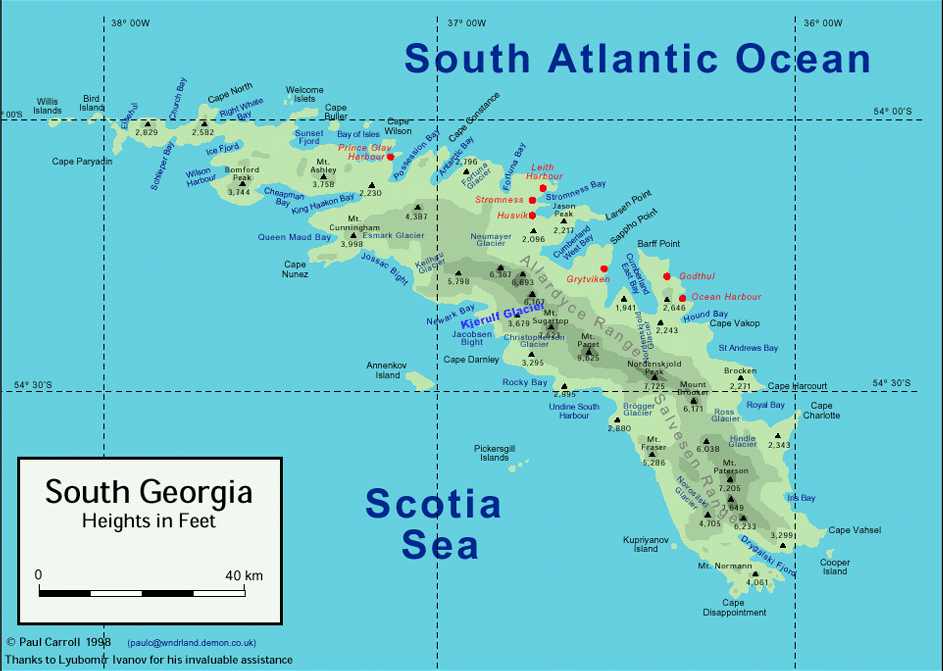
Map of South Georgia

"Certainly no great urging was needed, and one at a time they jumped from the rocks into the boat, leaving behind them without a second thought dozens of personal little items which only an hour before had been considered almost indispensable."
page 280

Rescue had finally come.  However, like always, it had been extremely difficult to achieve.  Upon reaching South Georgia, Shackleton realized that he would have to cross the island to reach Stromness whaling station in order to bring rescue.  After climbing mountains, scaling vertical drops, and missing their target several times, Shackleton and the two other men with him finally reached Stromness and did the first thing anyone in their situation would want to do: take a bath and shave.  After retrieving the other three men from the other side of the island, Shackleton organized several attempts to retrieve the men marooned on Elephant island.  In their excitement they abandoned personal belongings.

This behavior reminds me of my dogs.  If my dogs are playing with their toys and they hear someone come home, they immediately drop it and run to see them with tails wagging.  It may sound degrading to compare marooned men to dogs, but there are a few psychological similarities between the two groups.  When somebody leaves a dog, the dog thinks that it might be the last time they see the person, especially with our sporadic schedules.  Similarly, the marooned men believed they would never see their homes or loved ones again while stuck on that island, so when they saw the ship that would rescue them, they cared only about returning home and seeing all that they used to enjoy seeing.  I think this relationship between my dogs and the crew members reveals something about the innermost human tendencies: that in times of loss and fear, we prioritize the things in life that are truly important; the crew prioritized their homes while my dogs prioritize their owners(one of the oddest comparisons I've made, but, still, it works). Peyton Schneider raised a very good point in her blog "Why Not" when she said that the crew's experience gave them a new appreciation for nature.

Although some of the truly important pros of this voyage came with the improvement of the crew members' characters, another huge accomplishment was made by Shackleton; not a single man died on the expedition.  Ironically, the same expedition that humbled him the most saw his greatest feat of leadership.  However, the effects of this voyage are still being felt today.  Through this book, readers are able to imagine themselves in the most dire of circumstances and imagine what they would do.  From what I observed, I am most like Shackleton, in that I am a very cautious and concerned person and I can never let myself fail any of my responsibilities or obligations. 

I have shown what I learned about myself.  What have you discovered about yourself?

Wednesday, July 27, 2011

Success (Chapters 4-6 of Part VI)

Endurance: Shackleton's Incredible Voyage
Alfred Lansing

"Then, at just after ten-thirty, Vincent spotted a clump of seaweed, and a few minutes later a cormorant was sighted overhead. Hope flared anew."
page 244

Throughout the voyage, Shackleton and his crew lived in constant fear of missing South Georgia, which would result in their deaths on the open Atlantic.  Suddenly, with the sighting of seaweed, those fears were dismissed as seaweed serves as a signal that land is near.

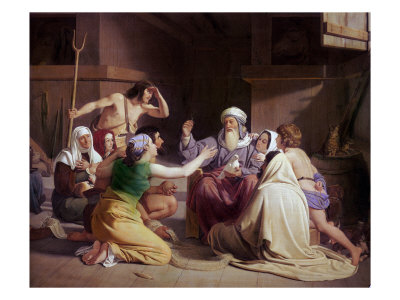
This scene is similar to the story of Noah from the Bible.  Noah, in order to escape a flood sent by God, survived on a boat for around two months.  Eventually, when the rains stopped, Noah sent birds to search for a sign of land.  After some unsuccessful trips, a dove brought to Noah an olive branch.  This olive branch served as a sign that there was land and salvation.  In both cases, people trapped on a boat were assured by plant life that land and salvation were near.


Sure enough, the crew spotted South Georgia a little later.  However, several attempts at landing saw the crew turned back by both wind and tide.  However, their efforts paid off and they were able to land.  Their survival was now ensure, but what would become of the group they left behind on Elephant Island?

Hell on Water (Chapters 1-3 of Part VI)

Endurance: Shackleton's Incredible Voyage
Alfred Lansing

"It was obvious that the burden of responsibility Shackleton had borne for sixteen months had nibbled away somewhat at his enormous self-confidence."
page 220

Now, for the increase of tension I presume, Lansing describes the events experienced by Shackleton's group while the other group was surviving on Elephant Island.  The sea-going group's experience can be fairly accurately described in one word: hell.

It's appropriate because it's a sea of fire.
 
The group was living in constant misery; water was constantly splashing into the boat, fixed positions caused stiff joints and made worse preexisting conditions, deer hair from sleeping bags got everywhere, and there was a constant stench from a slime in the sleeping bags.  However, not everything was unfavorable.  Since Shackleton was responsible for getting his crew into and out of this hell, he was under just about the most immense pressure anyone could ever endure.  This pressure, which seemed to culminate in, the miseries of the voyage in the Caird, had changed his personality for the better.  He became less self-centered.  The vast responsibility put on him made him realize that the lives of his crew, and anyone for that matter, should be prioritized over honor.  This made him a more caring and contributing individual.

A similar situation is found in The Lord of the Rings series (I had to even out The Lord of the Rings and Harry Potter references).  From the earliest days of the Fellowship of the Ring, there was considerable tension between Legolas, an elf, and Gimli, a dwarf.  At that point in time, there had been an ancient hatred between the two races.  Although this hatred resulted mainly from mistrust, a sense of superiority developed in both races which was especially strong in Legolas and Gimli.  However, as a result of overcoming life-threatening obstacles together, Legolas and Gimli abandoned the ancient feud and embraced an open friendship.  Like Shackleton, both Legolas and Gimli abandoned their egos after overcoming hardships and prioritized the protection of friends.

Does that not just make your heart melt?
 
Although conditions on the boat were abysmal, it was seeming that the group was going to be able to reach South Georgia and, by extension, the rescue of the rest of the crew.  However, as we have seen in this story before, the sea is always unpredictable.

Tuesday, July 26, 2011

Hope (Chapters 4-6 of Part V)

Endurance: Shackleton's Incredible Voyage
Alfred Lansing

"There was almost never any mention of the most probably reason of all . . . the Caird had been lost."
page 203

The crew fought to retain their optimism.  They had overcome too many obstacles to find out that Shackleton had died and help would never come.  In addition, optimism was a necessity if they wished to maintain unity and cooperation within the group; some men were likely to break if they thought that the Caird, Shackleton's ship, had been lost. In order to protect against the elements as well as brighten everyone's outlooks, the group build a shelter out of the boats and rocks.  Through the use of polysyndeton, Lansing portrays the importance of the newfound comfort by adding emphasis on each aspect: "Other men took positions on the ground, wherever it looked the snuggest, or the driest, or the warmest."  In addition, through dialogue, Lansing portrays the group's efforts to raise morale by discussing treats from home: " 'Do you like doughnuts?' Wild asked.  'Rather,' McIlroy replied. 'Damned easily made, too,' Wild said.  'I like them cold with a little jam.' "  Not only does the conversation help the men think happy thoughts, it helps them believe that they will return to England to enjoy those treats.

The blocking of unfavorable outcomes from one's mind is also found in the fifth Harry Potter book, The Order of the Phoenix (I apologize for the frequent Harry Potter references, but one has to admit that there are a lot of similarities!).  During the The Order of the Phoenix Harry battles Dolores Umbridge, the newest addition to the Hogwarts staff and secretary in the Ministry of Magic, and Cornelius Fudge, the Minister of Magic.  Both Umbridge and Fudge take every opportunity they can to tarnish the credibility of Harry and Dumbledore, who attempt to spread the true message that Voldemort had returned to his body.  Umbridge and Fudge deny his return (until, of course, Fudge actually sees him) to save morale.  Voldemort proved to be the biggest threat to the wizarding world, and to think that he had returned again would be absolutely devestating to wizards everywhere (except, of course, Voldemort's followers).  They didn't want the masses to lose faith in the Ministry, and they did not want to face the fact that their lives were in serious danger.


Despite the crew's optimism, conditions steadily got worse.  Their shelter was infested with stinking water, and, by August, two months past their estimations, no rescue ship had arrived.  It was beginning to appear that the group would have to sail for another island themselves.  Even worse, some members of the crew had lost hope that Shackleton was alive.

Freedom? (Chapters 1-3 of Part V)

Endurance: Shackleton's Incredible Voyage
Alfred Lansing

"But the tension in the air was unmistakable.  Both groups knew they might never see one another again."
page 193

Once again, things were looking bleak for the crew.  Although they found land, it was really not very different from the ice floes on which they had camped; supplies would eventually exhaust and there was extremely little chance of being discovered by other ships.  In a declarative sentence, Lansing portrays the scene of the realization by the crew that they could not stay on the island: "They would have to move."  The use of a simple declarative sentence helps Lansing portray the realization as both logical and unsettling.  The decision was reached that Shackleton and a few men would have to sail for South Georgia, some 800 miles away, to get a rescue crew.  Everyone realized that there was a strong chance that either Shackleton and his crew would die on the sea, or that the crew left on the island would die.  This marked the first time that every member of the  crew fully realized the likelihood of their survival; before, men were either bitterly pessimistic or complacent.

A similar situation is found in the last book of the Harry Potter series, The Deathly Hallows.  Nearing the end of the battle against Voldemort, having destroyed the vast majority of the fractions of Voldemort's soul, Harry realized that, in order to see his goal accomplished, he had to die.  A piece of Voldemort's soul had latched itself onto Harry's.  In a talk with Hermione and Ron, his two closest friends and companions, the whole group came to the same realization.  Harry left to die, leaving Hermione and Ron to destroy Voldemort.  In both situations, a group of companions realized that they were to be separated possibly forever.  In addition, the groups left behind were left to fight for their survival on their own.

Yes I realize that this is not the part where he dies, but it looks like it could happen here.

With Shackleton gone, the remaining crew would have to rely on their abilities to sustain them.  Only time will tell if the abilities of both groups would be enough to survive.
 

Monday, July 25, 2011

Land (Chapters 4 and 5 of Part IV)

Endurance: Shackleton's Incredible Voyage
Alfred Lansing

"During these past days he [Worsley] had exhibited an almost phenomenal ability, both as a navigator and in the demanding skill of handling a small boat.  There wasn't another man in the party even comparable with him, and he had assumed an entirely new stature because of it."
page 169

Once again, in the face of danger, another identity is realized.  During the storm, when the lives of the crew were at risk, Worsley acted on pure instinct, and realized his place among the crew as a leader.  In addition to giving Worsley's life and effort reason, his remarkable abilities gave the crew hope, something without which they had no hope of completing the trials of survival.  This sudden burst of ability is very similar to that made by Harry Potter.  It is indeed time for the inevitable Harry Potter reference!

In the third and fourth books of the Harry Potter series (The Prisoner of Azkaban and The Goblet of Fire respectively), Harry proved himself to be able to fight off the foul soul-sucking dementors and even Voldemort, the most powerful dark wizard ever to live.  These successes, though lacking any planning, renewed hope in his friends in the fifth book The Order of the Phoenix after they had feared being ill prepared for the attack made by Voldemort and his followers.  Like Worsley, Harry Potter was able to keep the hope of victory against danger alive by utilizing his unique and vital abilities.


However, not all members of the crew experienced a change in character during peril.  Orde-Lees, for one, remained lazy and selfish, agreeing to work only when the boat was about to sink because it would result in his death.  In addition, Shackleton remained extremely cautious even though he authorized the risky move of separating the boats.  "Shackleton, for once, agreed to the separation; at least, he granted Worsley permission to proceed independently."  By using a compound sentence, Lansing is able to portray Shackleton's decisions while also reminding the reader that those decisions do not mean that his personality has changed.

The crew managed to survive the ocean and reach Elephant Island, the first time the crew had seen land in over a year.  However, their trials are not yet over, as the island is not frequently visited.  Rescue is not yet ensured.

The Point of No Return (Chapters 1-3 of Part IV)

Endurance: Shackleton's Incredible Voyage
Alfred Lansing

"But this time there was no turning back, and they all knew it."
page 160


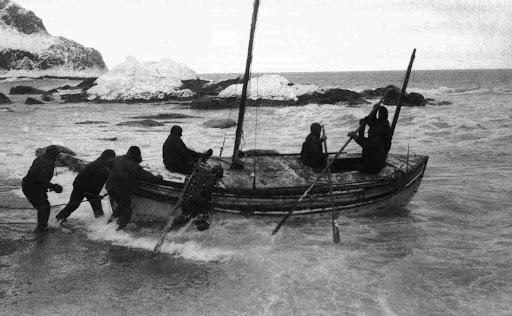
One of the ships used by the crew.

As the crew in their three ships were searching for land, the gravity of their condition sank in.  They realized that their choice to abandon their camp on the ice floe was irrevocable, and no efforts could be made to find a safe haven.  They now had to suffer the tortures that constantly plagued them, such as extreme cold, wet, strong winds, and illness. 

I note various, though much less dramatic, points of no return quite frequently, especially during the school year.  Being a notorious worrier, I am extremely hesitant to turn in any test.  The journey to the teachers desk to turn in my tests seems like crossing the ocean, and on the way I question my work constantly.  Usually, I consider turning back to check my work over.  However, despite the awareness of my academic peril, once I reach the desk, I cannot turn back; I have reached the point of no return and of no chance to edit my work.  I am forced to throw my test down as a castaway sailor would jump into an unpromising looking boat. 

Because of the miserable perils on the open ocean, morale dropped again.  In addition, the crew turned out to be drifting farther away from their destination.  This scene of irony drove some men to hopelessness.  "They were 124 miles nearly due east of King George Island and 61 miles southeast of Clarence Island-22 miles farther from land than when they had launched the boats from Patience Camp three days before!"  After the crew set sail for another island, Orde-Lees proved to be one of the main sources of anger that once again threatened to divide the group.  Almost constantly, he sought to avoid rowing, in which he was successful because the majority of people were glad to take his place in the hopes that they would warm.  His actions provoked very open spite.  Nearly everybody on his ship threw curses at him and ate in front of him hoping that it would make him ill. 

Another crack threatened to appear.

The Crack is Mended (Chapters 4-6 of Part III)

Endurance: Shackleton's Incredible Voyage
Alfred Lansing

"Without speaking, Clark reached out and poured some of his milk into Greenstreet's mug.  Then Worsley, then Macklin, and Rickenson and Kerr, Orde-Lees, and finally Blackboro.  They finished in silence."
page 127

Movie producers could not have created a more dramatic and heart-warming scene than that which occurred in the midst of this quote.  Before this point, an argument, sparked by Shackleton's refusal to allow an expedition to retrieve food from their previous camp, erupted in the tents.  In the fray of the argument, Greenstreet's meager, but only, milk ration was spilled because someone bumped into him.  The thought at being forced to go for a day without drink would bring any person to any extreme of negative emotion.  However, driven by pity, the other men sacrificed their drink to relieve this innocent bystander.  This marked an important development; the crack that threatened to divide the group was mended.

This act of loving sacrifice that solidified the bond between endangered lives is found in The Lord of the Rings (details will be mainly from the movie, but the same message is found in the books).  On the way to the land of Mordor, Frodo and Sam neared the end of their food supply.  In an act of love and dedication, Sam sacrifices the vast majority of his food supply to Frodo.  This sacrifice greatly strengthened the bond between the two, a bond threatened to break by the ring's souring of Frodo's attitude.  However, Sam's sacrifice of his essential needs allowed Frodo to remain dedicated to Sam, and the two were able to survive and to destroy the ring with help from each other.

Yet another Lord of the Rings reference.  Abby Koop would not be happy that I made two of them before even one Harry Potter reference.

Although the men proved to be willing to do anything to ensure the survival of their fellow crew members, conditions on the ice were not improving.  The ice floe was constantly breaking.  Erin Crowther brought up a good observation in her blog "Scatterbrain" that the series of catastrophes the crew experienced is comparable to that suffered by Japan this year.  Because of this Shackleton allowed nobody to leave for anything, even retrieving food.  "Almost continually there were sounds of pressure, apparently caused by the ice being jammed against the curving arm of the Palmer Peninsula."  Through the use of figurative language Lansing helps the reader to imagine the constant reminder to the crew of the grave danger in which they found themselves.

Eventually, the breaking of ice pushed Shackleton to order the crew into the boats in order to reach a nearby island.  However, danger followed, as approaching ice growth threatened to trap the crew in inhospitable ice.

Sunday, July 24, 2011

The Crack (Chapters 1-3 of Part III)

Endurance: Shackleton's Incredible Voyage
Alfred Lansing

"But Shackleton was not an ordinary individual.  He was a man who believed completely in his own invincibility, and to whom defeat was a reflection of personal inadequacy.  What might have been an act of reasonable caution to the average person was to Shackleton a detestable admission that failure was a possibility."
page 103

Despite Shackleton's earnest efforts to preserve peace within the crew at their new and permanent camp, his ego threatened to undo his efforts.  He can't face even the idea of failure, which in this instance was running out of food stores.  He convinced himself that there was enough food to see them through their situation.  Slain seals were even ordered to be left where they were by Shackleton, unable to accept the fact that they needed to hunt in order to survive.  His refusal to allow an increase in food supplies made some of the crew lose trust in him.

While reading this section, I noticed something about me that connected me with the rest of the crew.  Because I have to choose a quote and an example of a literary term, finding those things is my chief concern while reading.  However, I have noticed that I tend to choose quotes and literary term examples from the beginning of the section, because I fear that there won't be another opportunity later in the chapter.  Yes. I am a hoarder. 
I'm not that kind of hoarder!

Like the crew, I am looking for any opportunity to fulfill my obligations and needs as quickly as possible, because I fear that waiting will only make me miss my opportunity.

There is something I find peculiar in Shackleton's behavior and attitude.  Although he was unwilling to admit that the crew might be in need of more food, he authorized the killing of many of the crew's dogs.  Perhaps this act shows that he was not too stubborn.  Shackleton's order, although made in the interest of the survival of the crew through ensuring a decrease in food consumption, further alienated his crew.  The crew was faced with a dilemma.  "Then on January 13, a rumor spread that Shackleton was considering killing the dogs to ease the drain on the food supplies . . . .  But the fundamental, underlying factor in these discussions was that, for many men, the dogs were more than so many pounds of pulling power on the trail; there was a deep emotional attachment involved."  The crew had to choose between starving to death and killing the dogs, who earned the love of most of the crew through loyal service.  Most of the dogs were eventually killed.  Although it ensured the crew's survival, their morale dropped dangerously.

Because of the unpopular decisions made by Shackleton and ennui (Look! I remembered a vocabulary word), the crew could not acknowledge, with happiness, the progress made by the ice floe toward Paulet Island and safety.

The chip had expanded into a crack.  Will the crack allow the crew to shatter?

The Chip (Chapters 4-6 of Part II)

Endurance: Shackleton's Incredible Voyage
Alfred Lansing


"These weeks of primitive living had been peculiarly enriching.  The men had been forced to develop a degree of self-reliance greater than they had ever imagined possible . . . .  In some ways they had come to know themselves better."
page 87

Even though death was an almost certainty, life on the ice floe was enjoyable.  Few of the men even missed their British societies.  Life on the ice provided a new and more simple outlook on life; men were forced to be productive to survive.  Also, because of the simplicity of life, the true identities of the men became evident to everyone, especially themselves.  This retreat into nature is also seen in the Disney movie The Lion King.  Like the stranded crew, Simba was forced into the wild after the death of his father Mufasa.  Simba meets two friends, Timone the meerkat and Pumbaa the warthog, who teach him the basics of surviving in the jungle.  Over the years, Simba, with the help of his two closest friends, realizes his true identity.  However, the realized identities of the crew did not lead them to kill their uncles who usurped their fathers' thrones.  Nor were their uncles the lion versions of Jafar from Disney's Aladdin.

However, dissent and unhappiness found a way into the community of sailors.  From their base on a large ice floe, the crew was still able to see the trapped Endurance.  One day, the pressure from the ice failed, and the Endurance slipped into the ice waters of the southern Atlantic.  Lansing describes the sadness of the crew in an analogy: "But the reaction was largely a sentimental one, as after the passing of an old friend who had been on the verge of death for a long time."  By use of the analogy, Lansing compares the mourning of the crew after the loss of the Endurance to the mourning of a very sickly friend.  Although they knew eventually she would be lost, they still carried the sense of a lost friend with them. 

Trouble also came as a result of Shackleton's ill fated decision to leave their camp on the ice floe.  After drifting to the east for a few days and fearing the demoralization of the crew due to the use of profanity, Shackleton decided the best course of action was to make progress to the west.  However, this plan was unpopular with the crew from the start.  Shackleton attempted to assuage their uneasiness, he ordered an early feast in celebration of Christmas.  However, this did not succeed in permanently keeping spirits high.  McNeish, who saw himself as a lawyer, refused to push the boats any further, arguing that he was not legally bound to the crew since the Endurance sank.  Shackleton was able to convince him and the others that they were still bound by contract, but he never stopped fearing a large mutiny.  In addition, the crew was forced to return to their camp after reaching impassible ice.  The sense of failure, fatigue, and mistrust had created a chip in the unity of the crew that, if not repaired soon, would result in the shattering of the crew.

Barbarism (Chapters 1-3 of Part II)

Endurance: Shackleton's Incredible Voyage
Alfred Lansing

I'm sorry.  It had to be done.

"Worsley, however, was far from distressed.  He wrote in his diary that same night:  "The rapidity with which one can completely change one's ideas... and accommodate ourselves to a state of barbarism is wonderful.""
page 67

Worsley's quote depicts the chief dilemma the crew faced: maintain humanity and die, or accept barbarism and live.  After the crew abandoned ship, Shackleton challenged them to prioritize their possessions; all personal possessions that provided no useful purpose had to be left behind.  Shackleton himself threw down coins and even a Bible given to him by the Queen.  Not just inanimate objects were sacrificed; the crew was forced to kill several puppies who would only be a burden, as they could pull no weight.  (I don't think would EVER be able to do this.  I was on the verge of tears just reading about it.)  Once the crew started moving and a permanent campsite was established, dissent threatened to tear the crew apart from within.

One of the crew members, who was nicknamed Orde-Lees, created tension by his egotistical and lazy personality.  Every other crew member complained about his unwillingness to pull his weight and his giving of extremely small rations.  However, Shackleton was not able to address this behavior, as it changed when Orde-Lees was confronted by him.  Lansing, utilizing advanced diction, writes, "With Shackleton, however, he was obsequious-an attitude which Shackleton detested." Obsequious is a synonym for obedient. Lansing (aside from making me look up the word "obsequious") used advanced diction to portray Shackleton's struggle to address Orde-Lees' unpopular behavior.

The struggle of the men to survive is similar to the story in William Golding's Lord of the Flies.  In both stories, the victims of a wreck are forced to survive by adopting barbaric methods of survival, especially brutal hunting techniques.  However, in Lord of the Flies the leader of the stranded children, Jack, resorts to tyranny and murder in order to survive while Shackleton strives to maintain order and peace as much as possible. 


Will Shackleton succeed in maintaining peace, or will the crew succumb to violence and dissent?  Only time will tell.

Saturday, July 23, 2011

Resilience (Chapters 3-8 of Part I)

Endurance: Shackleton's Incredible Voyage
Alfred Lansing

The aurora australis.

"There was very little to occupy them, and they were in closer contact with one another than ever.  But instead of getting on each other's nerves, the entire party seemed to become more close-knit."
page 42

The expedition began as planned.  After several stops on islands and practical jokes by the crew, the ship finally encountered the dangerous ice.  After escaping an ice floe, in an allusion to the conquistador Balboa, Warsley, a crew member, wrote in his journal, "We feel as pleased as Balboa when, having burst through the forest of the Isthmus of Darien [Panama], he beheld the Pacific."  The crew shared Shackleton's sense of importance.  However, the opportunity for progress would not last.

The ship became trapped by the floes of ice, and the crew faced certain death by starvation.  Despite all odds, they managed to survive their icy captivity.  Every man pulled his weight to maintain the ship and to hunt the seals and penguins for food.  Unexpectedly, Shackleton's impulsive hiring of the crew allowed them to survive.  It turned out that Shackleton was very perceptive and a good judge of character.  This was made evident when the polar winter-literally months without the sun-finally came. 

Even though nearly thirty men were forced to close quarters, they got along fine.  In fact, only one person ever posed a threat to the peace: a man by the name of John Vincent who sought to establish himself as the most dominant of the crew.  However, after a brief talk with Shackleton, he dropped his delusions of grandeur.  The crew was able to entertain itself through dog sled races, gambling, music, and performances.  In addition, the landscape itself helped maintain the morale of the crew: the majestic icebergs and stunning aurora australis lights captivated them.  In another show of leadership, Shackleton was able to lead his men through the winter by maintaining their morale.

The ship, on the other hand, proved unable to resist the pressure of the ice, and Shackleton ordered the crew to abandon ship.

The story of adventure and peril reminds me of the story of The Lord of the Rings written by J. R. R. Tolkien.  Like the crew, the members of the Fellowship of the Ring faced both dangers from the outside and within.  The forces of the Dark Lord Sauron and mistrust within the Fellowship threatened to destroy their cause: to destroy the ring.  The Fellowship was able to withstand the pressures and grow closer to each other.  While reading about the crew's resilience to each other, I could only think of one quote about Frodo's resilience to the ring made by Elrond in the Peter Jackson movie The Fellowship of the Ring: "He has shown great resilience to its evil."

The Voyage Begins (Chapters 1 and 2 of Part I)

Endurance: Shackleton's Incredible Voyage
Alfred Lansing


The actual sinking of the Endurance.

"Cynics might justifiably contend that Shackleton's fundamental purpose in undertaking the expedition was simply the greater glory of Earnest Shackleton-and the financial rewards that would accrue to the leader of a successful expedition of this scope.  Beyond all doubt, these motives loomed large in Shackleton's mind."
page 12

This quote accurately describes the character and methods of Sir Earnest Shackleton, the leader of the expedition of the Endurance across Antarctica.  This obsession of not just wealth and fame, but the challenge itself, propelled the bold actions of the 20th century explorer.  The very expedition, which most thought to be folly in the first place, and the hiring of seamen that resembled the shopping of tools made manifest his immutable will and his willingness to make sacrifices to see it fulfilled.  However, Shackleton was not completely ruthless in his leadership.

When the Endurance began to sink in the ice off of the coast of Antarctica, Shackleton sought only to save all he could form the ship.  Although most captains of the time would choose death with the ship, Shackleton ordered men, dogs, and supplies off of the ship and onto the ice.  By the use of personification, Lansing portrays the dedication of captains to their ship.  "And dying as she [the Endurance] was, she cried in agony."  Shackleton suppressed his attachment to the ship and showed his true leadership of men in his decision to choose life over honor.

Although the Endurance had already set out on her mission before the crew was left stranded on ice, the true expedition that would test the endurance of the crew had just begun.  You may be saying to yourself, "Christopher, how can you possibly know that after reading only two chapters?"  The answer lies in Lansing's use of foreshadowing.  "Though he certainly was aware that their situation was desperate, he could not possible have imagined then the physical and emotional demands that ultimately would be placed upon them, the rigors they would have to endure, the sufferings to which they would be subjected."  Lansing gives the reader an early taste of the main action that will occur later in the book.

I can make a connection to the sinking ship that is rather close to home.  My grandfather came to this country from Italy in 1956 on the Andrea Doria, which collided with the Swedish Stockholm during his voyage.  I once asked him about the experience, and one detail that is in this book was also in his testimony: the extremely loud sound.  However, the Andrea Doria, being a passenger vessel, created a tremendous amount of chaos when she sank.  Both ships left their crew traumatized.


Here is a link if you are interested in learning more about the Andrea Doria: http://library.thinkquest.org/17297/andrea_home.htm.